1911's Placer Phase
To use a California Gold Rush metaphor, I am definitely in the placer phase of my new porject’s content and ideation writing process. I have largely started with reading and re-reading a lot of secondary sources on the period I intend to write about but, in an attempt to break the cycle of spending way too much time “researching” and not enough time “writing,” I have also jumped right into the primary sources.
My approach to developing the structure of this project is to start with the available online newspapers starting with January 1, 1911, and just reading through the headlines and articles and letting the stories on those pages be my guide. Even with that relatively narrow base of sources as a starting point, I still have a lot to look at. Thanks to the California Digital Newspaper Collection maintained by the University of California, Riverside, I have more than 10 state and city newspapers from the year available to me, most notably for my purposes the San Francisco Call.
On the front page of the main news section of the Call for January 1, 1911 is a ridiculous overabundance of starting points for my project. I barely have to leave that page to find a week’s worth of stories to explain. For example, the main stories on that page are about the tragic deaths of two aviators in plane crashes the day before. But, strikingly, it’s not just that this was front page news across the state that day, nor that one of the deaths occurred at an airshow in Los Angeles. In fact, the connections between San Francisco and the newfangled technology–with its commercial and military potential–ran even deeper and will help me recapture for readers a sense of the period by casting their minds back to a time when air travel was literally in its infancy.
Here are the two opening paragraphs for chapter 1–“January”–I am working on:
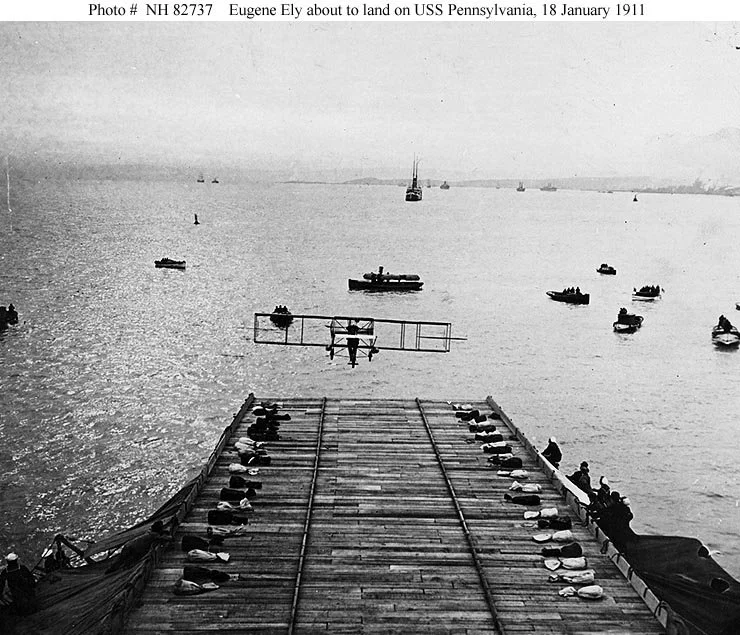
Notice the row of 50 lb. sand bags lining both sides of the specially-constructed wood plank landing platform? They were connected across the runway with a rope suspended 8” above the deck that successfully caught the hooks attached to the underside of Ely’s “landing gear” that quickly and safely brought him to a stop.
As the new year began, tragedy dominated the headlines of every major newspaper across California. In two separate and unrelated incidents on New Year’s Eve Day, John B. Moisant and Arch Hoxsey, “America’s foremost aviators,” were killed while performing at air shows. Moisant, a recent winner of $10,000 ($350,000) for the fastest flight from the Belmont Park racetrack on Long Island around the Statue of Liberty and back, died while trying to land his 50-horsepower aircraft on a field outside New Orleans. Hoxsey’s death was even more dramatic as he fell from over 500 feet “where he had gone to better, if possible, his world’s altitude record of 11,474 feet,” which he had set less than a week before, in front of a crowd of several thousand in Los Angeles.[1] One of the many new technologies of the era that was beginning to captivate imaginations was human flight. But as these twin tragedies clearly illustrate, it was still an imperfect and dangerous endeavor. Several newspapers published alongside reports of their deaths, a list of aviators and balloonists killed in 1910.[2] It was less than a decade earlier, in December 1903, that the Wright brothers made their historic powered flight. For the next several years, aviation enthusiasts and engineers from around the world continued to advance the technology but never flying more than a few minutes at a time and it would be another three years before the first recognized commercial passenger flight would take place, a twenty-three minute trip across Tampa Bay. (Although this was not the first flight with passengers, which happened prior to 1911.) Military officials in San Francisco had a keen interest in the new technology. Among the many articles reporting on the two deaths in the Call that day, it was noted that an “aviation meet” was scheduled to take place over the water of the San Francisco Bay at the end of that week, featuring among others the Wright brothers, and organized by First Lieutenant Paul W. Beck of the U.S. Army’s Signal Corps, the branch of the military charged with communications. In addition to the “usual number of novices and amateurs” that were expected to compete for prizes, the Army and Navy arranged for up-and-coming daredevil pilot Eugene Ely to attempt to land a plane on the deck of the specially-outfitted cruiser Pennsylvania anchored in the bay.[3] The previous November in Virginia, Ely had successfully taken off from the deck of the cruiser Birmingham and as it would turn out, succeeded on January 18 in his effort to land on the warship. Unfortunately, later that year, just two days shy of his twenty-fifth birthday, Ely was killed while flying at an exhibition in Georgia.[4]
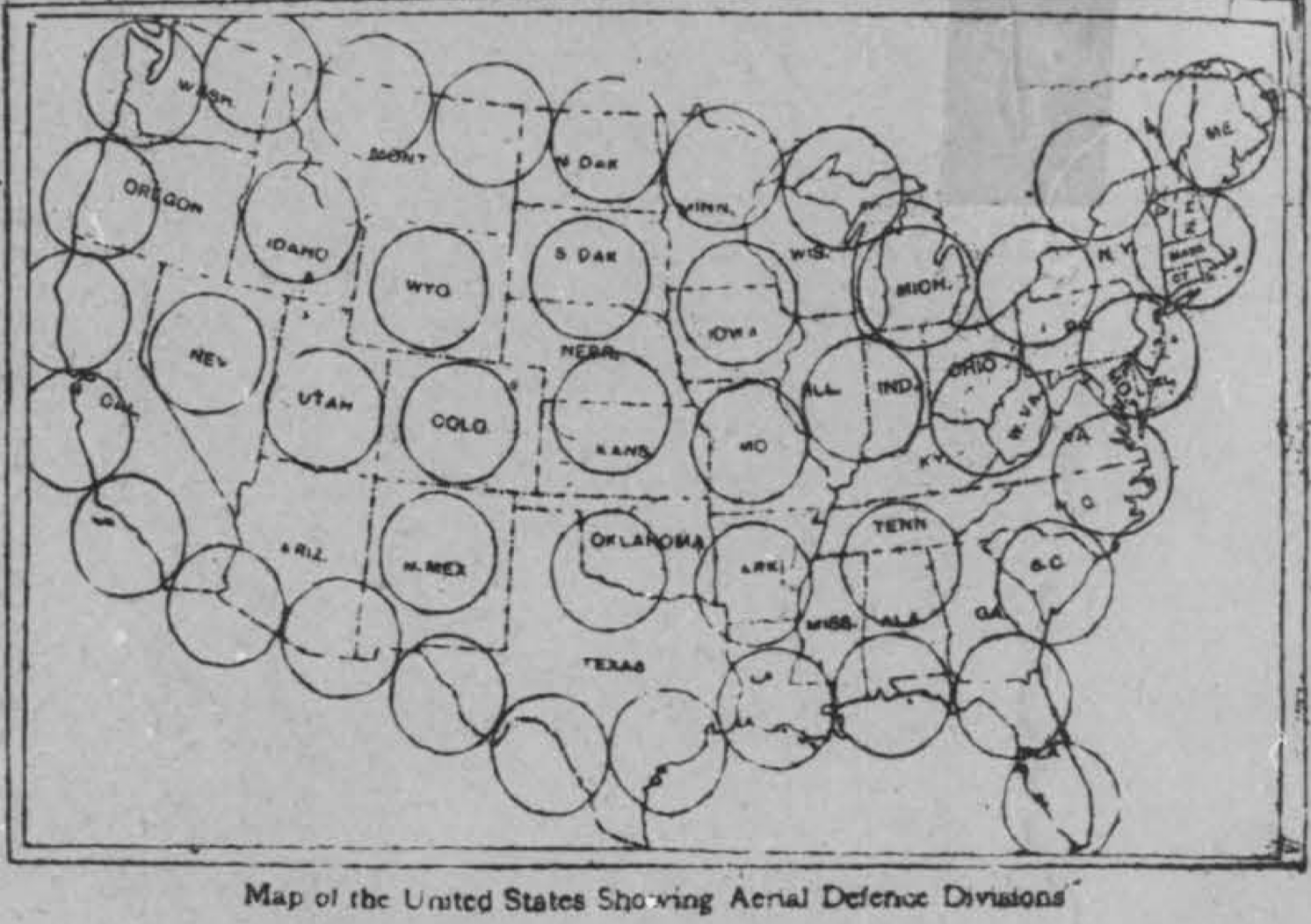
Lieutenant Beck’s commanding officer, Brigadier General James Allen, had already started sounding the alarm in Washington about the U.S.’s increasing vulnerability to attack by air as European nations began “building up formidable aerial fleets.” The Signal Corps had purchased their first aircraft from the Wright brothers eighteen months earlier for $30,000 ($1,100,828), to begin training Army pilots for observation flights. The first prototype of that plane actually killed an army officer–the first known fatality by a powered aircraft–during a demonstration flight in 1908. By January 1911, there was still only one licensed pilot in the army. In a remarkable coincidence, the Call also published as part of its Sunday supplement for January 1, a full page story on the efforts by General Allen to convince his superiors and Congress to invest $430,000 ($15,114,183) in purchasing forty-three of the latest aeroplane models to be placed at forty-three strategically placed stations around the United States. (For some reason, when calculating the per station cost, $10,000, Allen claimed that the latest model of aircraft would cost only $5,000, not the $30,000 it paid less than two years earlier.) An appropriations bill to conduct experiments “for war purposes” was expected to reach the floor during the next session of Congress and following Ely’s successful demonstration, the Secretary of the Navy and Secretary of War supported the request.[5]
One final note regarding this day’s reporting was that ubiquitous in the newspapers reporting Hoxsey’s and Moisant’s death were advertisements for another new technology as equally revolutionary and, as we will see, equally dangerous as the airplane: the automobile.
[1] “Moisant Wins Statue Race,” New York Times, October 31, 1910; currency figures in parentheses are given in 2026 dollars calculated at www.in2013dollars.com/us/inflation; “Moisant Killed While Attempting to Land and Hoxsey is Victim of Fearful Fall,” San Francisco Call, January 1, 1911.
[2] “Death is Fate of Many Airmen,” San Francisco Call, January 1, 1911; “Thirty-One Victims of Aeroplane in the Year,” San Francisco Chronicle, January 1, 1911.
[3] “Birdman to Try Thrilling Feats,” Sacramento Union, January 2, 1911.
[4] “Eugene Ely's Flight to USS Pennsylvania, 18 January 1911 -- Narrative and Special Image Selection,” and “Eugene B. Ely, Aviator, (1886-1911),” Department of the Navy, Naval Historical Center, accessed September 6, 2026, https://web.archive.org/web/20100412192818/http://www.history.navy.mil/photos/events/ev-1910s/ev-1911/ely-pa.htm and https://web.archive.org/web/20120819022500/http://www.history.navy.mil/photos/pers-us/uspers-e/eb-ely.htm.
[5] “The Protecting Wing of the Aeroplane,” San Francisco Call, January 1, 1911; “On This Day: The First U.S. Military Airplane,” Smithsonian National Air and Space Museum, accessed September 6, 2026, https://airandspace.si.edu/stories/editorial/day-first-us-military-airplane.