1911: An Idea
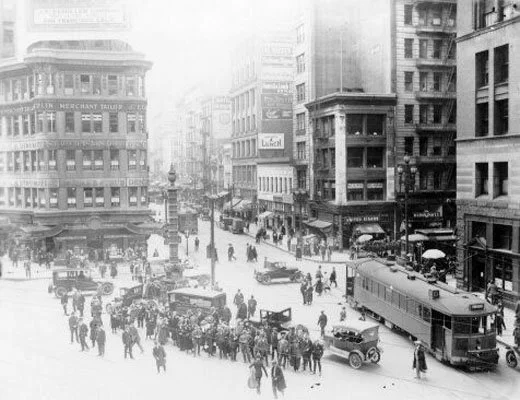
Lotta's Fountain on Market Street, 1911.
As a historian, I have always been intrigued by the idea of trying to understand the day-to-day lives of people living in extraordinary times. This desire has been excited over the past five years as I have lived through some truly extraordinary times. Perhaps even as far back as 2016 with the election of Donald Trump as President but accelerating in 2020 with the onset of a global pandemic, life as a Californian has been a nonstop barrage of social, political, and economic developments. Even amidst the “shutdown” of Covid-19, the way an individual experienced day-to-day life did not really “slowdown.” There was always something: remote “learning” for two young children, schedules and precautions for grocery shopping, meetings and new “modalities” for work events. Hanging out at bars and restaurants may have come to a complete stop, but the need to be social or engage with others did not as easily stop–and, if they did, the anti-social consequences of that forced isolation created a host of negative consequences that are still being revealed.
All of this is to say that I have been intrigued by the idea of really focusing in on a small period of time to fully explore the ways in which an individual might have experienced living it. One such way I have seen is to focus in on a single year in a particular place. The place is easy. Given that my dissertation focused on San Francisco and the importance of the city in the early years of statehood makes it a compelling choice. I was initially thinking of the year 1877. One of the interesting aspects of California is how it differed from or led historical developments in the United States and given the importance of that year nationally, I was/am intrigued by that question for such a pivotal year. But I also wanted to look at a year that was particularly San Franciscan-Californian. And thus, I have found that the year 1911 is exactly that. The year 1911 probably does not ring any bells or excite any passions with most readers of history. It does not signify the beginning or end of a war–perhaps the most common subtext to simply stating a year: 1066, 1776, 1865, 1945–nor does it signify the beginning or end of some arbitrary marker in time: 1700, 1900, 2000.
But, in California, 1911 signifies an exceptional moment in the state’s history. From the second day of that year, when the state’s thirty-ninth legislature was sworn in through December 24 that ended their second session of the year and on the third day of January when Hiram Johnson became the state’s twenty-third governor, California witnessed political developments of an unprecedented magnitude (then or since). The initiative, referendum, recall, and women’s suffrage were just several of the most notable achievements of the year. State operatives led in the attempt to form a serious third political party, the Lincoln-Roosevelt League, with former president Theodore Roosevelt as its candidate and Johnson as vice president. Nationally, it was the heyday of Progressivism and California played a significant role in its ideas and advancement.
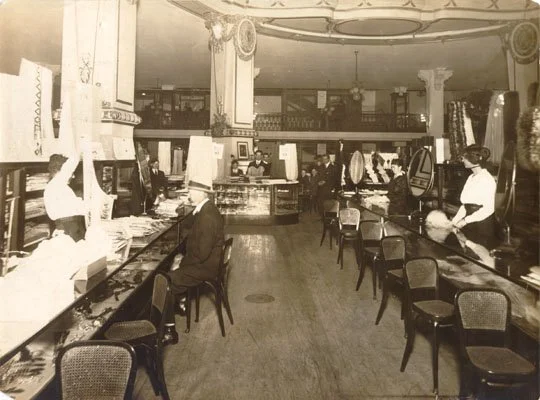
"Laces and Trimmings Department" at the City of Paris department store, 1911.
As the largest and most powerful metropolis on the west coast San Francisco was the center of power and attention in 1911. Although by the 1920 census Los Angeles would finally gain the top spot never to relinquish it. And indeed, this growing rivalry also found expression in 1911. Just months before, in October 1910, the Los Angeles Times Building was bombed by union sympathizers, killing 21 people. This conflict between labor (which held “undisputed sway” in San Francisco) and capital (led by the pugnacious publisher of the Times Harrison Grey Otis) reflected both the national conflicts between those two forces and the internal one between the northern and southern ends of the state.
This rivalry also found expression in the growing demand for prohibition and anti-vice measures, which the residents of Los Angeles favored and San Franciscans vehemently, and successfully, rejected until the Great War, taking great pride in being the “Paris of the West.” In March of this year, the “Municipal Clinic” opened that offered venereal disease testing for prostitutes working in the infamous Barbary Coast, essentially legalizing sex work in a prescribed part of the downtown.
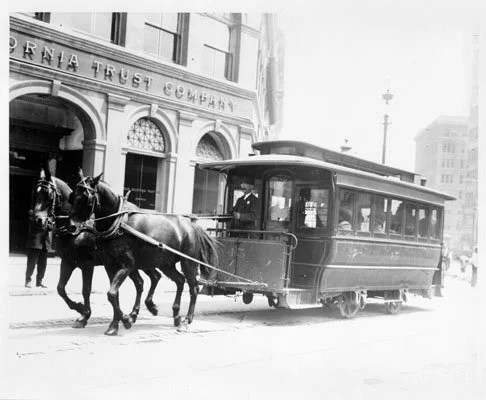
Horse car shuttle from Market and Sutter streets to Ferry Building, 1911.
In San Francisco and California, the year 1911 saw a surge in the development of the conservation/environmental movement as John Muir and the Taft administration battled over the Hetch Hetchy reservoir; Congress awarded the Panama Pacific International Exposition to the city to celebrate the opening of the Panama Canal, which would see more than 18,000,000 visitors in 1915; and fantastic new technologies including the telephone, flight, and automobiles, all of which benefited and plagued the city.
The careful reader will no doubt notice that I seem to be eliding my discussion between San Francisco and California, and indeed I am. As I learned from Robert Cherny, one of if not the leading historians of San Francisco, James Bryce, an early writer of California history, wrote in in his book American Commonwealth in 1888, “California, more than any other part of the Union, is a country by itself, and San Francisco a capital…San Francisco dwarfs the other [western] cities, and is a commercial and intellectual centre, and source of influence for the surrounding regions, more powerful over them than is any Eastern city over its neighborhood.”[1] Sowhile I intend to stay focused on or “based in” San Francisco as much as possible, for much of the state’s early history, California was San Francisco and in this very period where that became less true, to understand San Francisco is to understand or contrast it to other parts of the state, most notably Los Angeles. My hope is to provide a reader with some sense of what it was like to live in San Francisco in 1911. What were the issues, concerns, promises, and people that would have been a part of the lives of the city’s residents and, of course, then as now, they did not live in isolation from the larger context of their state, or their country for that matter.
[1] Robert W. Cherny, A Short History of San Francisco,” (Reno: University of Nevada Press, 2026), 39.