Robber Turns Hero
I intended to post the following news story as an example of the many seemingly absurd or unbelievable stories I encounter in Progressive-era newspapers. I cannot easily describe what makes it such a typical story. It is the improbability of the scenario that epitomizes the stories I regularly read. The daily newspapers in San Francisco–of which there were between four and six major ones during my time period–like all sources, need to be read carefully and with a healthy dose of skepticism. Although I am not a huge fan of present-day journalism, the liberties taken in reporting and political bias of early twentieth century journalists, makes knowing "the facts" difficult. And in San Francisco, as each paper tried to earn readers or argue a very particular point of view, that can make what may seem like a good source, tricky.
I frequently encounter newspaper articles that start a story with "I know a friend that..." and then proceeds to make some point or moralize based almost entirely on an unsubstantiated personal anecdote. Another common device is the good samaritan that overhears a conversation aboard some form of public transportation–often a conversation that suggested an impending white slavery abduction–that then leads to an arrest.
I am often faced with the dilemma of trying to use the little bits of information I can find about my topic and qualify that with a caution about the didactic or sensational purpose with which the information is presented.
Below is a short example that caught my attention by the headline that I laughed at its improbability. But, the more I pondered this particular story, the less willing I was to write it off as a tall tale. Here is the article:
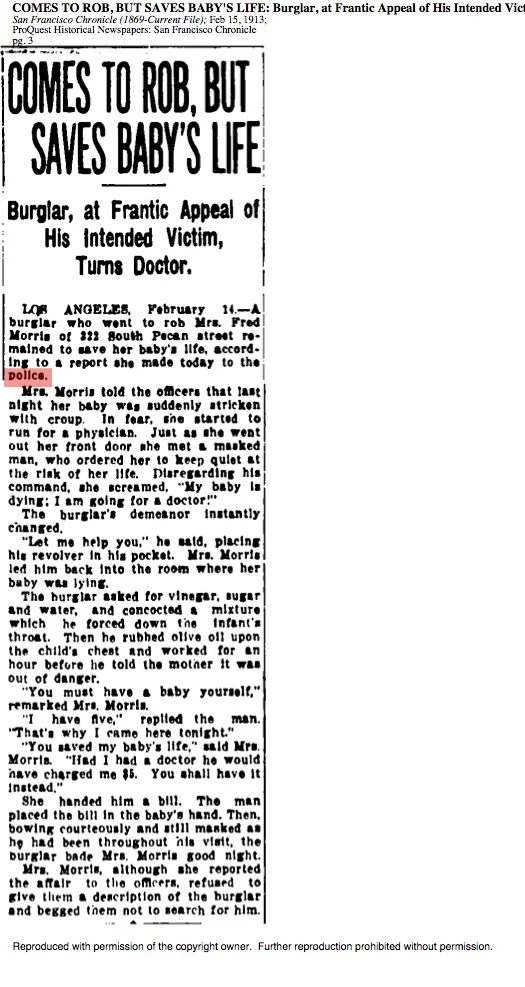
I was initially doubtful that an armed burglar would so easily transition to a concerned father. But the story provides the context to explain that leap: he, too, was a parent that would take enormous risks–she by pushing aside an armed robber to get help for her baby; he by taking up a firearm and committing several felonies–for the sake of family. Upon further reflection, it seemed perfectly believable that the same man could perform acts of the highest and lowest character. Poverty is not a personality trait but a condition.
This type of article and approach has also changed my thinking about the “white slavery” panic of the early twentieth century. I initially dismissed almost entirely the arguments Progressives made about the practice as hysteria. And, yet, in the light of what we know about sex slavery still today, it would be foolish to think coordinated and extensive networks of “procurers and pimps” did not exist.
Of course, you still have to laugh at the effective remedy for croup: "vinegar, sugar and water...forced down the infant's throat.